
Live 1-on-1 video · adults 18+
Talk to strangers on video, one person at a time
Omigo Chat puts you face to face with someone new, right in your browser. Press start, say hi, and see where it goes. Not clicking? Tap Next and meet someone else.
- No sign-up form
- Works on phone and laptop
- Report and block on every profile




What happens when you press start
- 1
Press start
No form, no profile to build first. You join the queue as a guest and the site looks for someone else who is waiting.
- 2
Allow camera and mic
Your browser asks once, at the moment a match is ready, and as soon as you say yes the other person’s video appears next to yours, usually mid-sentence, in a room you have never seen, somewhere you have probably never been.
- 3
Talk, or move on
Stay as long as it is good. Next unlocks a few seconds in. Hanging up always works.
What you can do once you’re talking
People come here to practise a language, to pass a slow evening, or just to hear how somebody on the other side of the world spends their Tuesday, which turns out to be far more interesting than it sounds once the somebody in question is nine time zones away, just finishing a day you are about to start. Whatever brought you, the controls are the same. There aren’t many.
- Start: open Omigo Chat in a browser and tap start. There is no sign-up form first.
- Camera and mic: your browser asks when a match is ready.
- Next: unlocks a few seconds into each call. Hang up works at any moment.
- Messages: text someone you talked to if you would rather type than talk.
- Report or block: from the other person’s profile. Blocks can be undone later.
- Cost: matched calls start with a free stretch; before it ends, the call shows the per-minute coin rate.
Staying safe without turning cold
Safety advice for stranger chat often reads like a list of reasons not to do it. It doesn’t have to. You can be warm and still careful; the two just apply to different things. Being careful is not the same as being suspicious of everyone, and in practice the people who enjoy random chat most are the ones who have decided in advance what is theirs to keep, so that they can relax about everything else.
Be open about
- Your opinions, tastes and stories
- Your country, or a broad region
- What you do, in general terms
- Your first name, if you like
Keep to yourself
- Surname, street, school or employer
- Social media handles and phone number
- Anything with an address or ID on it in the background
- Money, gift cards or account details, ever
If someone keeps steering back to the second list, that tells you what they are there for. Believe what they show you. You can end it without explaining.
Never done this before? Start here
On a random video chat you get no warm-up. A face appears, already looking at you, and the clock starts. Here is the part people forget: the person on the other side is in exactly your spot, wondering what to say. You don’t need to be impressive. You need to be the one who speaks first. The rest of this page is a few ways to make that easier.
Pick a reason
Practising a language, killing time, hearing how people live somewhere else. Having a reason gives you something to ask about.
Decide what stays private
Choose now which details you won’t share: surname, city, school, workplace, handles. Deciding in the moment is harder.
Give it a time limit
Twenty minutes is plenty. You are less likely to stay in a chat that has gone flat when there is an end in sight.
Openers that get more than a one-word answer
“Hi” works. It just hands all the effort to the other person. A question they can answer without thinking too hard does better. Steal any of these.

“Where in the world am I talking to right now?”
Easy to answer, and it almost always leads somewhere, because the place someone lives comes with weather, food, time zones and a dozen small complaints that are easy to ask about.
“What were you doing before you opened this?”
People like describing their evening. You get a story instead of a yes.
“Be honest, how many people did you skip before me?”
A little self-aware humour lowers the pressure for both of you.
“I’m practising my Spanish. Mind if I try?”
A clear request. People say yes to specific asks more than vague ones.
“What’s the best thing you ate this week?”
Food is safe ground.
“What’s something people get wrong about where you live?”
Invites an opinion, which is where real conversation starts.
Then the real trick: ask about their answer, not a new question. If they say they were cooking, ask what. If they say they are in Lisbon, ask whether the hills are as bad as everyone says. Following up is what turns an exchange into a conversation. Not every opener will land with every person, and that is completely normal; the aim is not to find a magic sentence but to make it easy for the other person to say something, anything, that you can then pick up and run with.
Five situations, and what to do in each
None of these is rare. It helps to have decided your move before it happens. Most bad moments in stranger chat are not dangerous, just uncomfortable, and the difference between someone who keeps going and someone who quits for good is usually whether they had already decided what to do when one of these came up.
- 1
They answer with one word.
Ask one more open question, ideally one about something you can actually see on their side of the screen, like a poster, a guitar in the corner or the fact that it is clearly the middle of the night where they are. If you get another single word, that is your answer. Thank them and move on; some people are just browsing.
- 2
There’s a silence and you panic.
Silence on video feels three times longer than it is. It really is that dramatic. Name it (“okay, my brain just emptied”) and laugh. It usually breaks the tension better than a new topic does.
- 3
They ask where exactly you live.
Give the country or a big region and turn the question around. If they push for a street, a school or a workplace after you have already given a general answer, that is not curiosity any more, and it is a perfectly good reason to leave.
- 4
They want to move to another app.
Say you would rather stay here. People who are worth talking to won’t mind. Leaving the site means leaving its report and block tools behind.
- 5
Something on screen is not okay.
Hang up straight away; you don’t owe a goodbye. Then open their profile and report them, and block them if you never want to see them again.
Knowing when to move on
Moving on is not rude on a random chat. It really is not. It is how the format works, and everyone on it knows that. A good rule: if after a minute or so neither of you has found a thread to pull, try someone new.
Some chats will be great for ten minutes and then run out. That is fine too. Say it was nice talking and go. Ending on a good note beats dragging something until it is awkward. If you find yourself staying only because leaving feels impolite, remember that the other person probably feels the same way, and that a friendly goodbye frees both of you to find a chat you will actually enjoy. Nobody keeps a list.
The only time to leave fast, with no goodbye at all, is when something breaks the rules or makes you uncomfortable. Hang up first, think second.
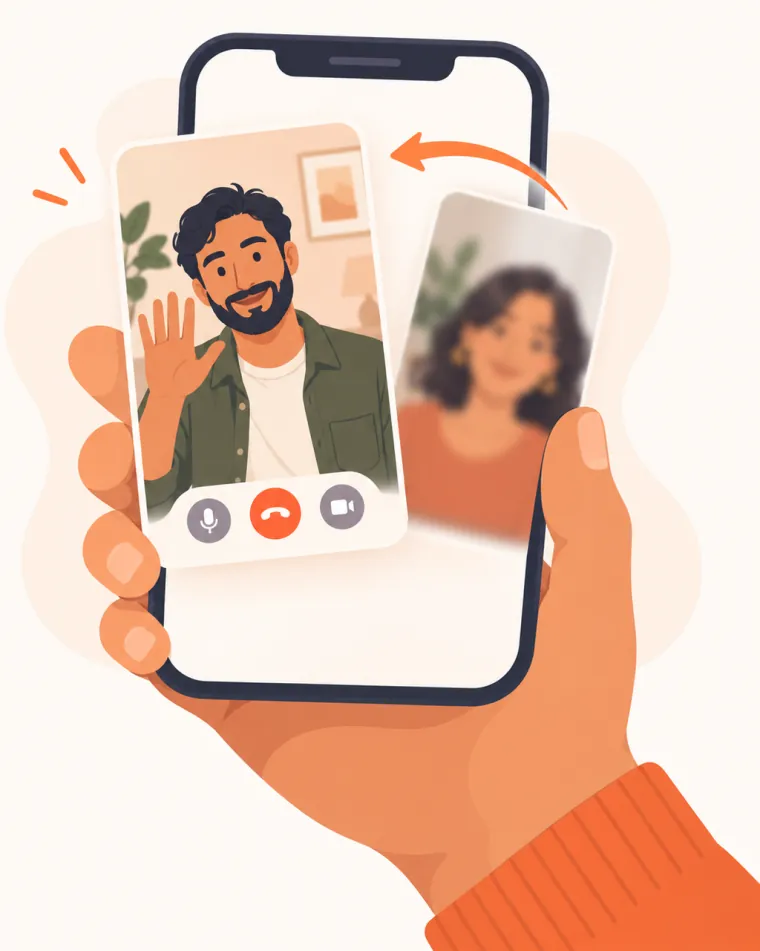
Somebody new is one tap away
No profile to fill in, nothing to download, and if the first person isn’t a match you just tap Next, and then Next again, for as long as it takes to find a conversation that sticks. Adults only, 18+. Switching from Omegle? Here is how Omigo Chat compares. Want to see other options first? We compared seven sites side by side.
Say hi to someone newTalking to strangers: quick answers
Where can I talk to strangers on video without signing up?
Right here. Omigo Chat lets you start a one-on-one video chat in your browser without filling in a sign-up form first. Several other sites work the same way; we compare seven of them on our Omegle alternatives page.
Is it safe to talk to strangers online?
It can be, if you keep personal details to yourself, stay on the platform instead of moving to other apps, and leave any chat that feels wrong. Use the report and block tools when someone crosses a line.
What should I say to a stranger on video chat?
Start with an open question that is easy to answer, such as where they are or what they were doing before. Follow up on whatever they say rather than jumping to a new topic.
How do I end a chat that is going badly?
Hang up. On Omigo Chat the hang-up button works at any time, and Next becomes available a few seconds into a call. If the person broke the rules, report them from their profile.
Do I have to show my face?
Video chat needs your camera on to work. You do not have to show anything that identifies you beyond your face, so check what is visible behind you before you start.